Prayers & patron saints
St. Teresa of Ávila: Her Life, Her Words and the Prayer “Nada te turbe”
St. Teresa of Ávila (1515–1582) was a Spanish Carmelite nun, a reformer, a mystic and one of the great writers of the Spanish language. In 1970 she became the first woman ever declared a Doctor of the Church. Her best-loved prayer is only nine short lines long: “Nada te turbe,” “Let nothing disturb thee.”
Below you will find her story, the full prayer in Spanish with a classic English translation, a few quotes you can trust because we have checked where they come from, and why so many writers and seekers feel she belongs to them.
Her life in brief
Teresa Sánchez de Cepeda y Ahumada was born in Ávila, in Castile, on March 28, 1515. She entered the Carmelite convent of the Incarnation in her hometown as a young woman, and for years she struggled with serious illness and with her own life of prayer, until a profound conversion in prayer changed her life.
In 1562 she founded a small, poor convent dedicated to St. Joseph in Ávila, the first of many houses of what became the Discalced Carmelites. She traveled the roads of Spain in carts and on mules founding convents, and she won over a young friar, St. John of the Cross, to bring the same reform to the men of the Order.
She died at Alba de Tormes on the night of October 4, 1582, the very night Spain switched to the Gregorian calendar, so the next day was October 15. That is why her feast is celebrated on October 15. She was canonized in 1622.
Mystic and Doctor of the Church
Teresa wrote because her confessors asked her to, and the result is one of the richest bodies of spiritual writing in Christianity: the Book of Her Life, The Way of Perfection, the Interior Castle, which describes the soul as a castle with many rooms leading to God at its center, and the Foundations, a lively account of her travels. Her letters show a warm, funny, practical woman.
On September 27, 1970, Pope Paul VI declared her a Doctor of the Church, a title given to saints whose teaching has special value for the whole Church. She was the first woman to receive it. Beneath her statue in St. Peter’s Basilica she is called mater spiritualium, mother of spiritual people.
The prayer “Nada te turbe”
These lines are known in Spanish by their first words and are often called St. Teresa’s Bookmark. Here is the Spanish text:
- Nada te turbe, nada te espante,
- todo se pasa, Dios no se muda;
- la paciencia todo lo alcanza;
- quien a Dios tiene nada le falta:
- sólo Dios basta.
“Let nothing disturb thee” in English
The most famous English version is by the American poet Henry Wadsworth Longfellow:
“Let nothing disturb thee, nothing affright thee; all things are passing; God never changeth; patient endurance attaineth to all things; who God possesseth in nothing is wanting; alone God sufficeth.”
Many people pray it slowly, one line per breath, when they feel anxious. Its message is simple: storms pass, God remains, and with God nothing essential is missing. It is also sung around the world in a well-known chant from the Taizé community.
Quotes from St. Teresa you can trust
Many sayings are attributed to Teresa online. These come from her own books, with their references:
- On prayer: “Contemplative prayer in my opinion is nothing else than a close sharing between friends; it means taking time frequently to be alone with him who we know loves us.” (Book of Her Life 8, 5, as quoted in the Catechism of the Catholic Church, 2709)
- On love: the important thing “is not to think much but to love much.” (Interior Castle IV, 1, 7, in a common English translation)
- On daily life: “the Lord walks among the pots and pans.” (Foundations 5, 8), a line that makes her a natural friend of anyone who cooks; see our post on the patron saint of cooks.
- On trust: “sólo Dios basta,” God alone is enough, from the poem above.
Why she is a patron for writers and seekers
Officially, Teresa is a Doctor of the Church and a reformer of the Carmelite Order, and in Spain she is honored as patroness of Catholic writers. EWTN lists her as patron of Catholic writers as well. Calling her the patron saint of writers and spiritual seekers is our own way of describing her, rooted in popular devotion: she was a woman who wrote her way toward God, honest about her doubts, and who spent her life searching for the center of the interior castle.
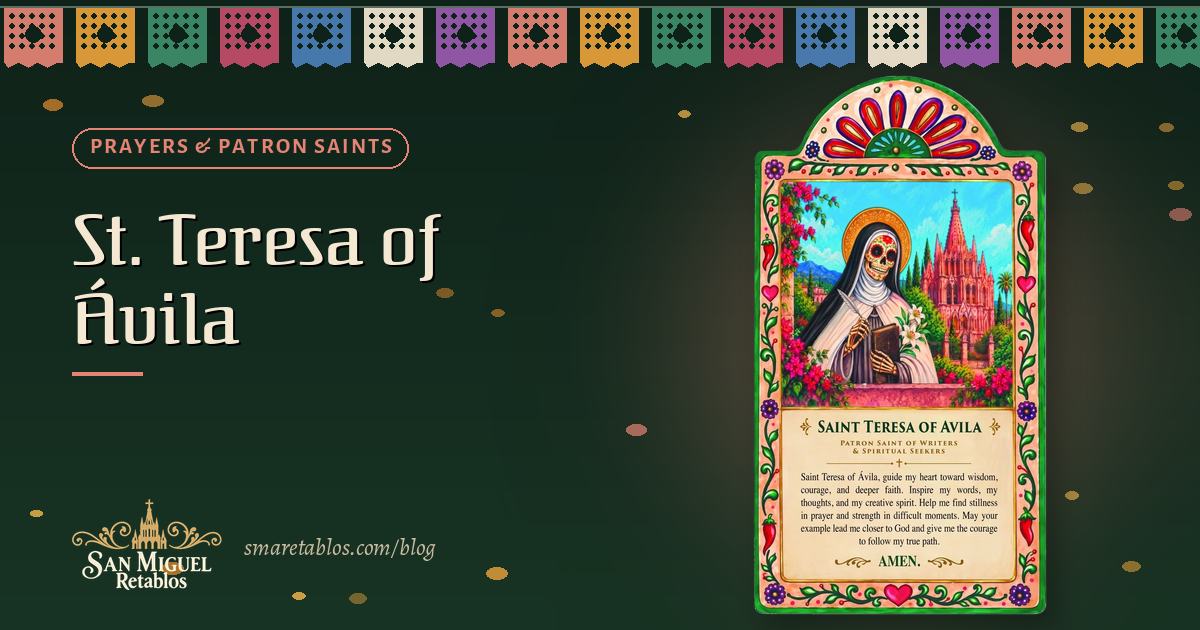
Our St. Teresa of Ávila retablo shows her as a Catrina in front of San Miguel’s pink Parroquia, with a prayer, a fitting gift for a writer, a student, a teacher or anyone on a spiritual journey. If you are new to the saints, our guide to patron saints is a good place to start.
Frequently asked questions
When is the feast of St. Teresa of Ávila?
October 15. She died on the night of October 4, 1582, when Spain moved to the Gregorian calendar, so the following day became October 15.
Who wrote “Nada te turbe”?
St. Teresa of Ávila. The poem is traditionally known as her bookmark, and the classic English translation, “Let nothing disturb thee,” is by Henry Wadsworth Longfellow.
Why is St. Teresa a Doctor of the Church?
For the depth of her teaching on prayer and the spiritual life. Pope Paul VI gave her the title in 1970, making her the first woman Doctor of the Church.
Is St. Teresa of Ávila the same as St. Thérèse of Lisieux?
No. Teresa of Ávila was a 16th-century Spanish Carmelite; Thérèse of Lisieux, the Little Flower, was a 19th-century French Carmelite. Both are Doctors of the Church.
If Teresa’s words have kept you company, our St. Teresa of Ávila retablo from San Miguel Retablos, printed on wood from an original painting by Leslie Kate, puts her prayer where you will see it every day.
About the author: Lesley B. Fay
Lesley B. Fay runs San Miguel Retablos from her studio at Hidalgo 52A in the Centro of San Miguel de Allende, Mexico, where she creates Catrina saint retablos with artist Leslie Kate. She writes about the traditions, saints and celebrations behind each piece.
Sources
- ewtn.com — www.ewtn.com/es/catolicismo/santos/teresa-de-jesus-15090
- vatican.va — www.vatican.va/content/paul-vi/es/apost_letters/documents/hf_p-vi_apl_19700927_multiformis
- press.vatican.va — press.vatican.va/content/francesco/es/messages/pont-messages/2014/documents/papa-francesco
- vatican.va — www.vatican.va/archive/ENG0015/__P9M.HTM
- hymnary.org — www.hymnary.org/hymn/SBSA1986/956