Saints & traditions
The Story of Our Lady of Guadalupe: Juan Diego, the Tilma and December 12

In December 1531, ten years after the fall of Tenochtitlan, an Indigenous man named Juan Diego said the Virgin Mary appeared to him on the hill of Tepeyac, just north of Mexico City. She asked for a church to be built there. When the bishop asked for a sign, she sent Juan Diego back with roses gathered in winter, and when he opened his cloak, her image was on it.
That cloak, the tilma, hangs today in the Basilica of Our Lady of Guadalupe, and her feast on December 12 is the most important religious day of the year in Mexico. Here is the story step by step, and why she means so much to Mexico and to the whole continent.
Juan Diego and the hill of Tepeyac
Juan Diego Cuauhtlatoatzin was a Nahua man who had become a Christian. According to the traditional account, on a Saturday morning in early December 1531 he was walking to Mass when he heard music on Tepeyac and saw a young woman who called him tenderly by name, “Juanito.” She said she was the ever-Virgin Mary, Mother of the true God, and asked him to go to the bishop, Fray Juan de Zumárraga, and ask that a church be built on that spot.
The bishop listened but did not believe him right away, and asked for a sign. Meanwhile Juan Diego’s uncle, Juan Bernardino, fell gravely ill, and Juan Diego tried to avoid the hill so he could fetch a priest. The Virgin met him on the road anyway. The account gives her words in Nahuatl, and they are now carved above the entrance of the Basilica: “Am I not here, I who am your mother?” She assured him his uncle would recover, and he did.
The roses and the tilma
On the morning of December 12 the Virgin told Juan Diego to climb to the top of the hill. There, in the cold of December, he found fresh Castilian roses. He gathered them in his tilma, the simple cloak worn by Indigenous men, and carried them to the bishop.
When he opened the tilma in front of Zumárraga, the roses fell to the floor and the image of the Virgin appeared on the cloth: a young woman with a dark complexion, hands joined in prayer, wrapped in a mantle of stars and standing on a crescent moon, with an angel at her feet. The bishop took the image to his church and had a chapel built at Tepeyac, as she had asked.
The best-known telling of the story is the Nican Mopohua, written in Nahuatl and traditionally attributed to Antonio Valeriano, and printed in 1649 by Luis Laso de la Vega. The dates are those of the Julian calendar used at the time: December 9 to 12, 1531.
The Basilica and December 12
The original chapel grew into an Old Basilica, finished in 1709. Since 1976 the tilma has hung above the main altar of the modern Basilica of Our Lady of Guadalupe, a round building at the foot of Tepeyac. It is considered the most visited Catholic shrine in the world, and on December 11 and 12 millions of pilgrims arrive, many on foot, by bicycle or on their knees.
On the night of December 11, parishes across Mexico sing las mañanitas to the Virgin, and on the 12th there are Masses, matachines dancers and processions with children dressed as little Juan Diegos. Juan Diego himself was canonized by Pope John Paul II at the Basilica on July 31, 2002, and called the first Indigenous saint of the American continent. His feast is December 9.
What Guadalupe means for Mexico and the Americas
For many Mexicans, the Virgin of Guadalupe is simply la Morenita, a mother who appeared to an Indigenous man, spoke his language and chose his people. Her image has accompanied the country’s history: when Miguel Hidalgo began the fight for independence in 1810, his followers carried her image on banners and hats.
The popes have recognized her reach far beyond Mexico. St. Pius X named her patroness of Latin America, Pius XII called her Empress of the Americas, and St. John XXIII called her Mother of the Americas. Today she is honored from Chile to Canada, and her image is one of the most familiar sights in Mexican homes, taxis, markets and kitchens. People read the details of the image in many ways; a few common interpretations:
- The mantle of stars, often seen as a sign that she comes from heaven.
- The moon beneath her feet, which some connect with a popular reading of the name Mexico as “navel of the moon.”
- Her joined hands: a woman at prayer, pointing beyond herself to God.
- The angel holding her mantle, often read as a bond between heaven and earth.
Bringing la Guadalupana home
Many families keep her image at the center of a home altar, with a veladora lit on December 12 or whenever there is a special intention. Others prefer a painted retablo, the small devotional image on wood or tin that has been part of Mexican homes for generations.
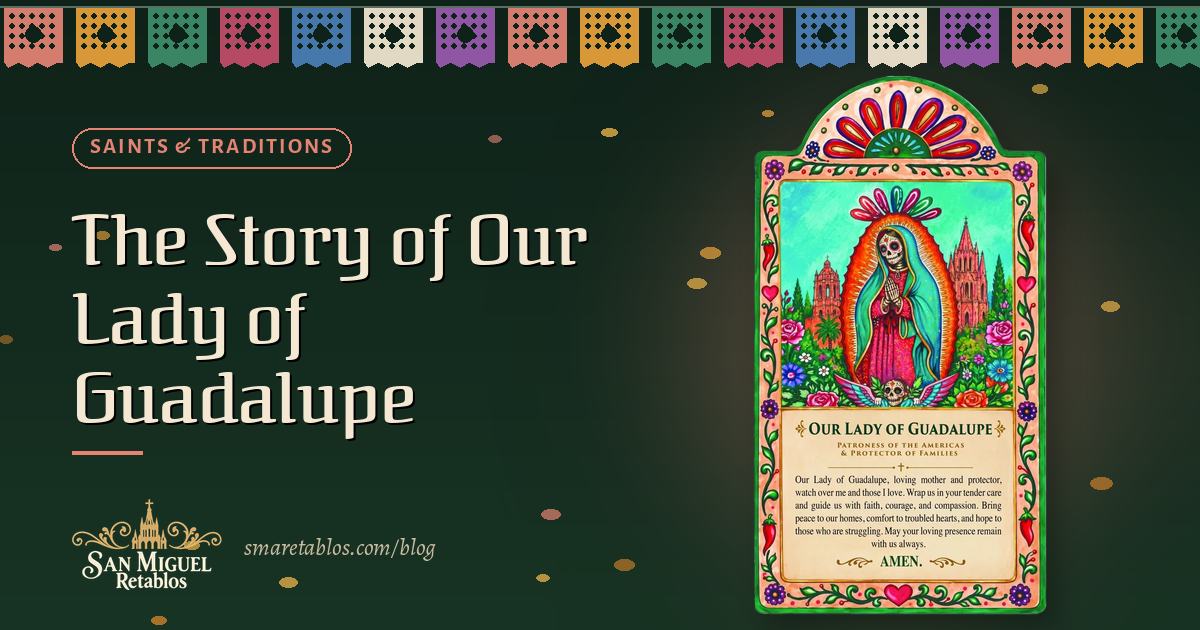
Our Our Lady of Guadalupe retablo shows her as a Catrina before San Miguel’s pink Parroquia, with a prayer, as patroness of the Americas and protector of families. The gift box adds a milagro charm, a prayer card, a candle and matches, a thoughtful present for a wedding, a new home or December 12.
Frequently asked questions
When did Our Lady of Guadalupe appear?
According to tradition, from December 9 to 12, 1531, on the hill of Tepeyac. Her feast is celebrated on December 12.
Who was Juan Diego?
Juan Diego Cuauhtlatoatzin, a Nahua man to whom the Virgin appeared. Pope John Paul II canonized him in 2002 as the first Indigenous saint of the American continent.
Where is the tilma of Juan Diego today?
Above the main altar of the Basilica of Our Lady of Guadalupe in Mexico City, where it has been displayed since the new basilica opened in 1976.
Why is she called Patroness of the Americas?
Popes have given her continental titles: St. Pius X named her patroness of Latin America, Pius XII called her Empress of the Americas and St. John XXIII Mother of the Americas.
If la Morenita watches over your family, our Our Lady of Guadalupe retablo from San Miguel Retablos, printed on wood from an original painting by Leslie Kate, is a way to keep her close every day of the year.

About the author: Lesley B. Fay
Lesley B. Fay runs San Miguel Retablos from her studio at Hidalgo 52A in the Centro of San Miguel de Allende, Mexico, where she creates Catrina saint retablos with artist Leslie Kate. She writes about the traditions, saints and celebrations behind each piece.
Sources
- aciprensa.com — www.aciprensa.com/recursos/historia-de-la-virgen-de-guadalupe-1080
- vatican.va — www.vatican.va/content/john-paul-ii/es/homilies/2002/documents/hf_jp-ii_hom_20020731_canon
- en.wikipedia.org — en.wikipedia.org/wiki/Our_Lady_of_Guadalupe
- en.wikipedia.org — en.wikipedia.org/wiki/Juan_Diego