Mexican folk art guide
What Is a Retablo? The History of Mexican Devotional Retablos

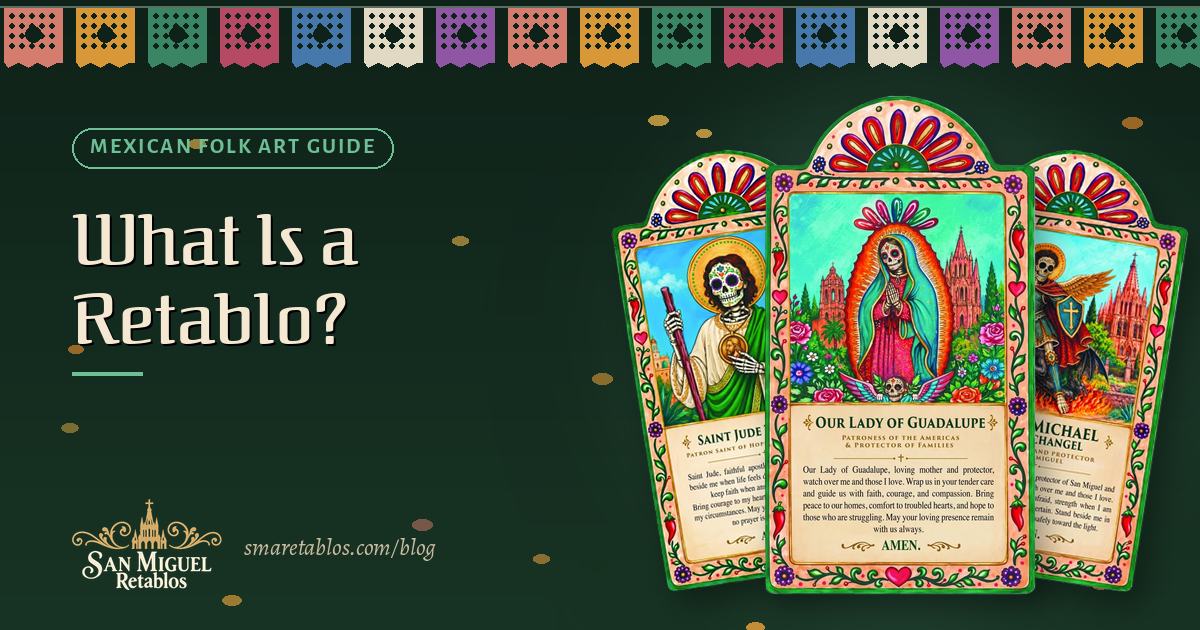
A retablo is a small devotional painting of a saint, the Virgin Mary or Christ, traditionally painted on a sheet of tin and kept at home for prayer. The word is Spanish and is usually traced to the Latin retro tabula, “the board behind,” because the first retablos were the great altarpieces that rise behind church altars in Spain.
In Mexico the word took on a humbler, more personal meaning. From the late 18th century on, it came to describe the small hand-painted images that families hung on their walls and set on home altars, and, in everyday speech, the ex-voto paintings people leave at shrines to give thanks for a miracle.
This guide covers where retablos come from, how a saint retablo differs from an ex-voto, and how to display and care for one in your own home.
From Spanish altarpiece to Mexican home
In Spain, a retablo is the altarpiece above and behind an altar. Some are single large paintings; others are carved and gilded wooden structures filled with sculpture, rising 40 feet or more in late medieval and Renaissance churches. The tradition crossed the Atlantic with the Spanish, and the towering gilded altarpieces of colonial Mexican churches are still called retablos today.
Over time, the same word was applied to much smaller painted images. Early devotional and votive paintings in Mexico were mostly on canvas and commissioned by wealthy patrons. That changed in the 18th century, when tin sheets became relatively inexpensive. Painters known as retableros could now produce small images on lámina, thin sheet metal, at a price ordinary families could afford.
The 19th-century tin retablos of saints
The tin retablo flourished in Mexico in the second half of the 19th century and into the early 20th. Workshops produced saint images by the thousands for home shrines, rarely larger than about 7 by 11 inches. Each showed a single holy figure with its traditional attributes so it could be recognized at a glance: Saint Michael with his sword and scales, Our Lady of Guadalupe in her starry mantle on a crescent moon, Saint Jude with the image of Christ on his chest.
These images were made to be used, not admired from a distance. They hung in kitchens and bedrooms, stood beside a candle and were passed down through families. Toward the end of the 19th century, cheaper printed chromolithographs from Europe began to replace them, and the hand-painted saint retablo declined. Many survivors are now in museums. The New Mexico State University Art Museum, for example, holds more than 1,700 nineteenth-century Mexican retablos, which it describes as the largest such collection in the United States.
Retablo vs. ex-voto: what is the difference?
The two are often confused because both are small paintings, often on tin, and in Mexico people commonly call both retablos. The real difference is their purpose.
- Saint retablo (santo): a portrait of one holy figure, made for a home altar and used for ongoing prayer. Saint images followed set conventions and varied little from one painter to the next.
- Ex-voto: from the Latin for “from a vow,” a painting of a specific event, such as an illness, an accident or a dangerous journey, in which the person believes a saint intervened. The saint floats above the scene among clouds, and a written testimony below tells the story and gives thanks. Ex-votos are left at churches and shrines to fulfill a promise.
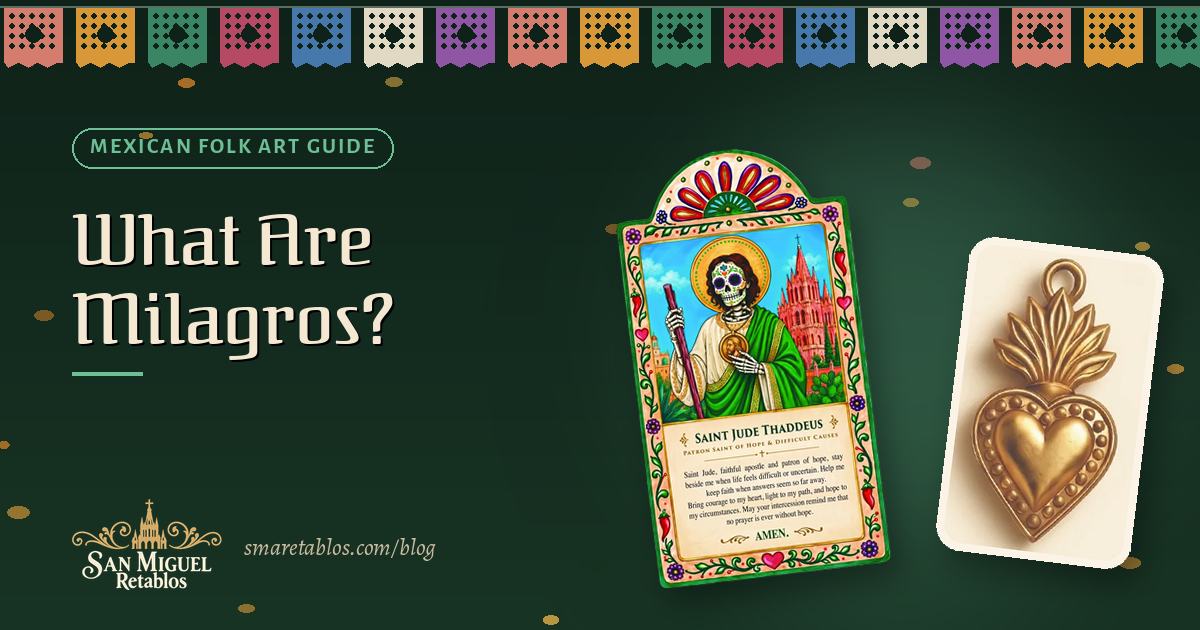
- Milagros: small metal charms shaped like hearts, legs, eyes and other forms, also offered in petition or thanks. Read more in our guide to Mexican milagros.
Where ex-votos live today
Ex-votos are still made. Nearly every Mexican church has some, and large collections cover the walls of shrines such as the Basilica of Our Lady of Guadalupe in Mexico City and San Juan de los Lagos in Jalisco.
Diego Rivera and Frida Kahlo were among the first to collect them as art. Kahlo’s collection is still displayed at her family home, the Casa Azul in Coyoacán, and she borrowed the ex-voto format, an image above a line of handwritten text, in her own paintings.
How to display a retablo at home
A retablo is meant to be close at hand. Traditionally it hangs at eye level or rests on a shelf or small table that serves as a home altar. A few ideas:
- Choose a calm spot you pass every day, such as an entryway, a kitchen wall or a bedroom shelf.
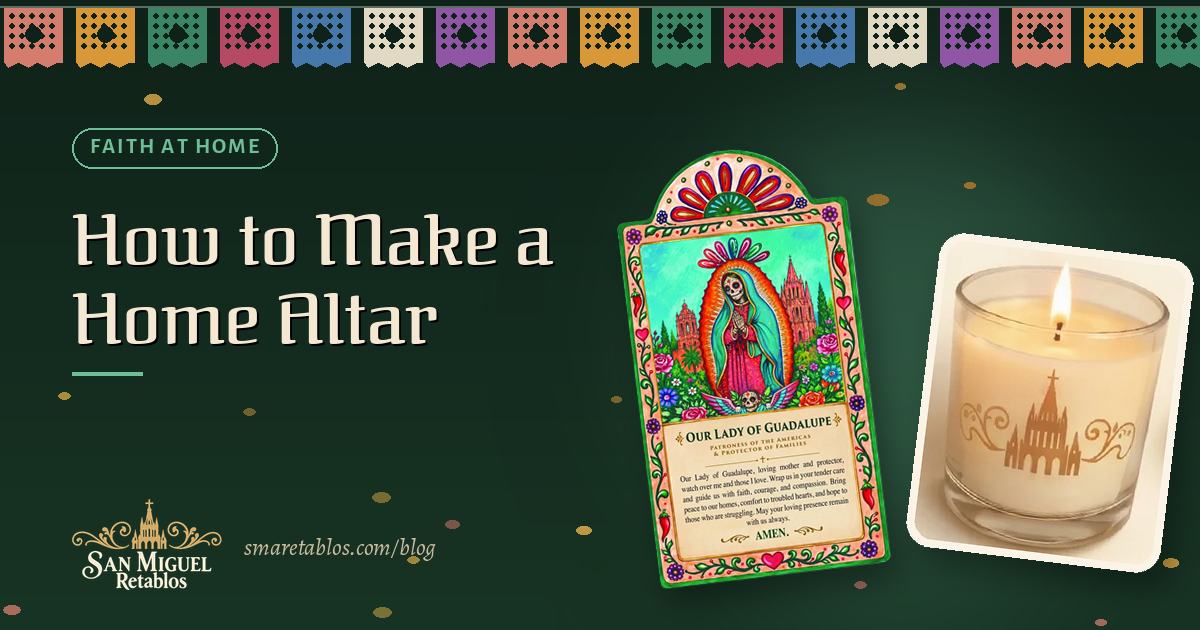
- Add a candle, a few flowers or a small glass of water to create a simple altar. Our guide to making a home altar walks you through it.
- Group several saints together, as many Mexican families do, or let one image stand alone.
- Place a saint near what it watches over: a patron of cooks in the kitchen, Saint Michael by the front door.
- Give one for a new home, a baptism, a birthday or a hard season. Our Catholic gift guide has more ideas.
How to care for a retablo
Antique tin retablos and contemporary pieces on wood need the same basic care: keep them dry, out of strong sun and away from heat.
- Hang it away from direct sunlight, which fades color over time.
- Avoid damp or steamy places, such as a bathroom or the wall directly above a stove.
- Keep candles at a safe distance and never leave a flame burning unattended.
- Dust with a soft, dry cloth. Do not use water, glass cleaner or polish on the image.
- If an antique tin piece shows rust or flaking paint, consult a conservator rather than cleaning it yourself.
A living tradition in a Catrina style
The retablo has never stopped evolving. Painters in Mexico still make saint images and ex-votos, and contemporary artists borrow the format for new work.
Our pieces at San Miguel Retablos belong to that contemporary branch, and we want to be clear about what they are: not antique tin paintings, but fine art prints on wood, 11 × 7 inches, made from original paintings by artist Leslie Kate. Each saint appears as an elegant Catrina in front of the pink Parroquia of San Miguel de Allende, with a prayer. Saint Michael the Archangel, protector of our town, and Our Lady of Guadalupe are two of the six saints in the collection.
Frequently asked questions
What does the word retablo mean?
It is the Spanish word for an altarpiece, usually traced to the Latin retro tabula, “the board behind.” In Mexico it also means a small devotional painting of a saint, and in popular use it often includes ex-voto paintings too.
Are retablos Catholic?
Yes. Retablos grew out of Catholic devotion and depict Christ, the Virgin Mary and the saints. Many people of other backgrounds also collect them as Mexican folk art and treat them with respect.
How can I tell an antique tin retablo from a modern one?
Antique saint retablos are hand-painted in oil on thin metal sheets and usually show age, such as small dents, rust at the edges or cracked paint. Contemporary retablos may be painted or printed on wood, metal or paper. A reputable seller should tell you plainly what a piece is made of.
Is a retablo a good gift?
Yes. A saint retablo is a traditional gift for a home blessing, a baptism, an illness or a loss, chosen to match the saint to the person or the need. Our guide to patron saints for every need can help you choose.
Our retablos are made in San Miguel de Allende and come gift-wrapped with a tag, or in a gift box with a milagro charm, prayer card, candle and matches. A good place to start is Saint Michael, the protector of our town.

About the author: Lesley B. Fay
Lesley B. Fay runs San Miguel Retablos from her studio at Hidalgo 52A in the Centro of San Miguel de Allende, Mexico, where she creates Catrina saint retablos with artist Leslie Kate. She writes about the traditions, saints and celebrations behind each piece.
Sources
- en.wikipedia.org — en.wikipedia.org/wiki/Retablo
- en.wikipedia.org — en.wikipedia.org/wiki/Votive_paintings_of_Mexico
- uam.nmsu.edu — uam.nmsu.edu/collections/retablo-collection.html
- latinamericanandcaribbeandesign.commons.gc.cuny.edu — latinamericanandcaribbeandesign.commons.gc.cuny.edu/?p=1947
- chilango.com — www.chilango.com/cultura/exvotos/