Faith at home
How to Make a Home Altar You Can Keep All Year

To make a home altar, choose a small, quiet surface you pass every day, place a holy image at the center, add a candle, and keep a few living or personal touches nearby, such as fresh flowers, a glass of water or photos of people you pray for. That is all it needs. The rest is the habit of stopping there.
Many people in the US first meet the idea of a Mexican altar through the Day of the Dead ofrenda, which is built for a few days each autumn to welcome the souls of loved ones. A year-round home altar is different. It is a permanent prayer corner, centered on Christ, the Virgin or a saint, and in many Mexican homes it has been part of daily life for generations.
Here is how to set one up, step by step.
Why keep a home altar
Catholic tradition calls the family home a “domestic church.” The Catechism of the Catholic Church recommends a prayer corner, with sacred scripture and images, as a place for personal and family prayer, a quiet spot that reminds you to pray even on busy days.
In Mexico, the altarcito is often where a family lights a candle before a trip, leaves a note during an illness or gives thanks after good news. You do not need permission, special training or expensive objects. You need a place and the intention to use it.
Where to place your altar
The best place is one you will actually see. A corner of the living room, a hallway shelf, a bedroom dresser or a kitchen wall all work.
- Choose a spot at eye level or a little lower, where you can stand or sit in front of it.
- Keep it apart from everyday clutter like keys, mail and chargers, so it reads as a sacred space.
- Avoid direct sun, drafts and anything flammable above the candle.
- If you live with children or pets, choose a surface high enough to keep flames and breakables out of reach.
- In a small apartment, a single wall shelf or the top of a bookcase is enough.
What to put on a home altar
Start with a few meaningful pieces and add slowly. A typical Mexican Catholic altar includes:
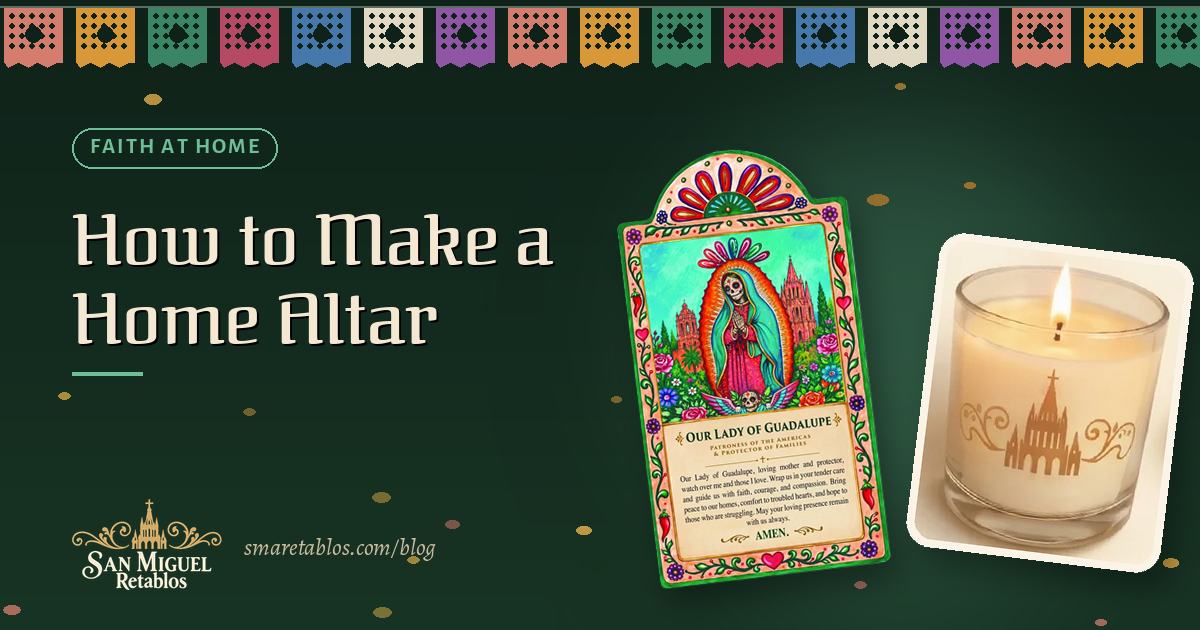
- A holy image at the center: a crucifix, a picture of the Virgin or a saint retablo. In countless Mexican homes this is Our Lady of Guadalupe, the protector of families.
- A candle: a tall glass veladora or a simple votive, lit when you pray.
- Fresh flowers: whatever is in season. Change the water often and remove them before they wilt.
- Water: a small glass of water or a bottle of holy water from your parish.
- Photos: pictures of family members you are praying for, living or departed.
- A Bible, rosary or prayer card: keep your daily prayers within reach.
- A cloth: a simple embroidered or white cloth to mark the surface as special.
Choosing a saint for your altar
Many families choose a saint linked to a name, a hometown or a present need: Saint Jude in hard times, Saint Michael for protection, a patron of cooks in the kitchen. Our guide to patron saints for every need can help you choose.
Writers, students and anyone on a spiritual path often keep Saint Teresa of Ávila, the 16th-century Carmelite mystic who became, in 1970, one of the first two women named a Doctor of the Church. Her short prayer “Nada te turbe” (“Let nothing disturb you”), with its closing line “Sólo Dios basta” (“God alone suffices”), is a beautiful text to keep on a card beside her image.
Keeping your altar through the year
A home altar should feel alive, not frozen. Small changes through the year keep it meaningful:
- Light a candle on the feast day of your saint, such as December 12 for Guadalupe or October 15 for Saint Teresa.
- Follow the Church seasons if you like: violet for Advent and Lent, white or gold for Christmas and Easter, blue for feasts of Mary.
- Add a few marigolds and photos of the departed in late October, or build a separate ofrenda for the Day of the Dead.
- Pin a milagro beside the image when you have a special intention.
- Dust weekly and replace flowers and water so the space always looks cared for.
Keeping it simple and respectful
A home altar is not a decorating project. Fewer objects, chosen with care, usually feel more prayerful than a crowded shelf. Treat holy images with respect: do not let them collect dust or sit under piles of things, and if an image becomes damaged, the traditional practice is to burn or bury it rather than throw it in the trash.
Most of all, use it. A minute of silence, a Hail Mary or a quick thank-you in front of your altar each day is what turns a shelf into a sacred place.
Frequently asked questions
Is a home altar the same as a Day of the Dead ofrenda?
No. An ofrenda is a temporary altar built around November 1 and 2 to welcome and remember the dead, with marigolds, food and photos. A home altar is a permanent prayer space centered on Christ, the Virgin or the saints, used all year.
Can I have a home altar if I am not Catholic?
Many people of different faiths keep prayer or reflection spaces at home. If you include Catholic images, treat them with the same respect a believer would.
Does a home altar need to be blessed?
It is not required, but many families ask a priest to bless their religious images, or the whole home, and keep holy water on the altar.
Where should a home altar face?
There is no rule for the direction it faces. Choose a place where you will see it every day and can pray without distraction.
If you are looking for a centerpiece, our Our Lady of Guadalupe and Saint Teresa retablos are made in San Miguel de Allende, and our gift box adds a candle, matches, a prayer card and a milagro, everything a new altar needs.

About the author: Lesley B. Fay
Lesley B. Fay runs San Miguel Retablos from her studio at Hidalgo 52A in the Centro of San Miguel de Allende, Mexico, where she creates Catrina saint retablos with artist Leslie Kate. She writes about the traditions, saints and celebrations behind each piece.
Sources
- vatican.va — www.vatican.va/archive/ENG0015/__P9H.HTM
- spiritualdirection.com — spiritualdirection.com/2014/06/21/how-do-i-set-up-home-altar
- fssp.com — fssp.com/the-home-altar-through-the-liturgical-year
- en.wikipedia.org — en.wikipedia.org/wiki/Teresa_of_%C3%81vila