Day of the Dead culture
La Catrina: The History and Meaning of Mexico's Elegant Skeleton

La Catrina is the elegant skeleton lady in a wide feathered hat who has become the best-known image of Mexico's Day of the Dead. She was born in the early twentieth century as a satirical print by the engraver José Guadalupe Posada, who called her La Calavera Garbancera. Decades later, the painter Diego Rivera dressed her in full and gave her the name we know today: La Catrina.
Her message is simple and a little mischievous: rich or poor, elegant or humble, we are all the same underneath, and death comes for everyone. Over time that warning has softened into something warmer, a symbol of remembrance and of a culture that looks at death with familiarity and even a smile.
Here is where she came from, what she means, and why so many people paint their faces as Catrinas today.
José Guadalupe Posada and La Calavera Garbancera
José Guadalupe Posada (1852–1913), born in Aguascalientes, was a prolific printmaker who illustrated the popular broadsheets of Mexico City. Many of his best-known images are calaveras, skeletons acting out scenes of everyday life, used to comment on politics and society.
Around 1912, near the end of his life, Posada created a skeleton head wearing only an elaborate European-style hat. He called her La Calavera Garbancera. A garbancero was a term for people of Indigenous descent who, hoping to climb the social ladder, sold chickpeas rather than corn and imitated European fashions while denying their roots. The image was a sharp critique: no matter how you dress, the bones underneath are the same. The figure became widely popular only after Posada's death.
Diego Rivera gives her a name
In 1947 Diego Rivera painted his great mural Sueño de una tarde dominical en la Alameda Central, Dream of a Sunday Afternoon in the Alameda Central, which today is displayed in the Museo Mural Diego Rivera in Mexico City. The mural gathers famous figures of Mexican history strolling through the park.
At its center Rivera placed Posada's skeleton, now with a full body and a long elegant dress, and called her La Catrina. The word comes from catrín, a well-dressed, fashionable man, a style associated with the Mexican upper class of the late nineteenth and early twentieth centuries. Rivera painted himself as a boy beside her and Posada at her other side, honoring the artist who created her. From that moment, La Catrina became a national icon.
What La Catrina means
La Catrina carries several layers of meaning at once:
- Equality before death: her fine clothes cannot hide that she is a skeleton, a reminder that death treats everyone alike.
- Social criticism: she was first a joke at the expense of people who denied their roots to look European.
- Familiarity with death: in Mexico death is often personified with affection and humor, part of the same spirit found in sugar skulls and calaveras literarias.
- Remembrance: today she appears in papel picado, costumes and ofrendas as a joyful symbol of the dead who return to visit.
Why people dress as Catrinas today
In recent years, painting your face as a Catrina or Catrín has become one of the most visible ways of joining the celebrations. In many Mexican cities, including San Miguel de Allende, people walk the streets in flowered crowns, elegant dresses and skull makeup during the Day of the Dead season, and you can read about it in our guide to the Day of the Dead in San Miguel.
For many, dressing as a Catrina is a way of honoring loved ones and celebrating Mexican identity. If you do it, a little respect goes a long way: learn the story behind the makeup, and remember that the heart of the season is the ofrenda and the families who are remembering their dead.
Why we paint our saints as Catrinas
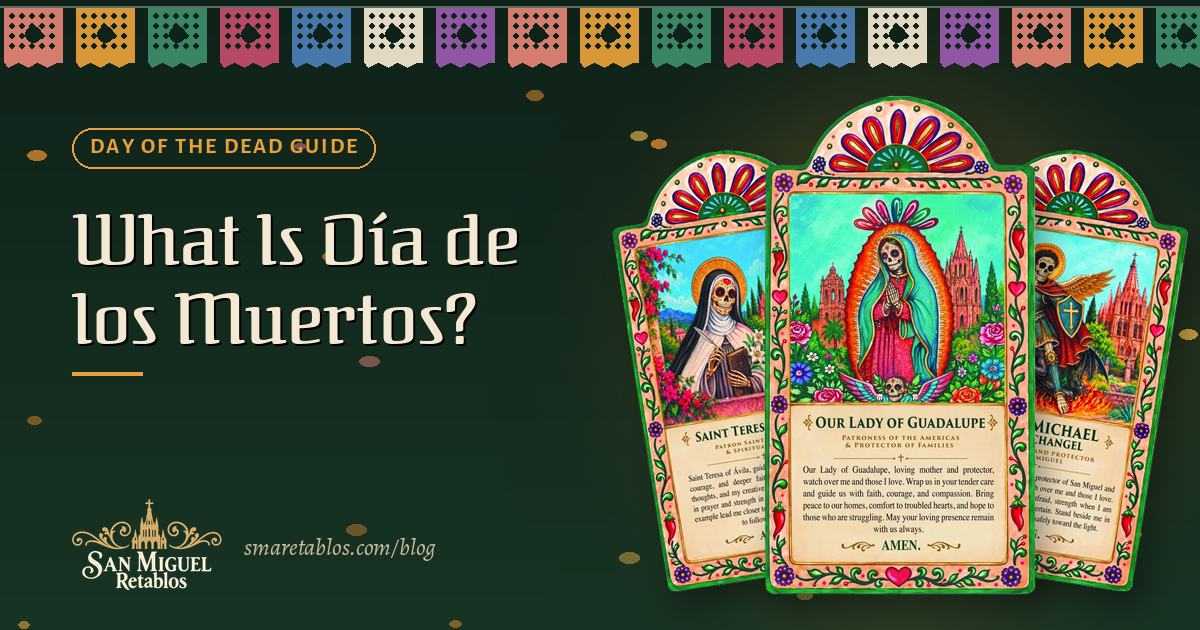
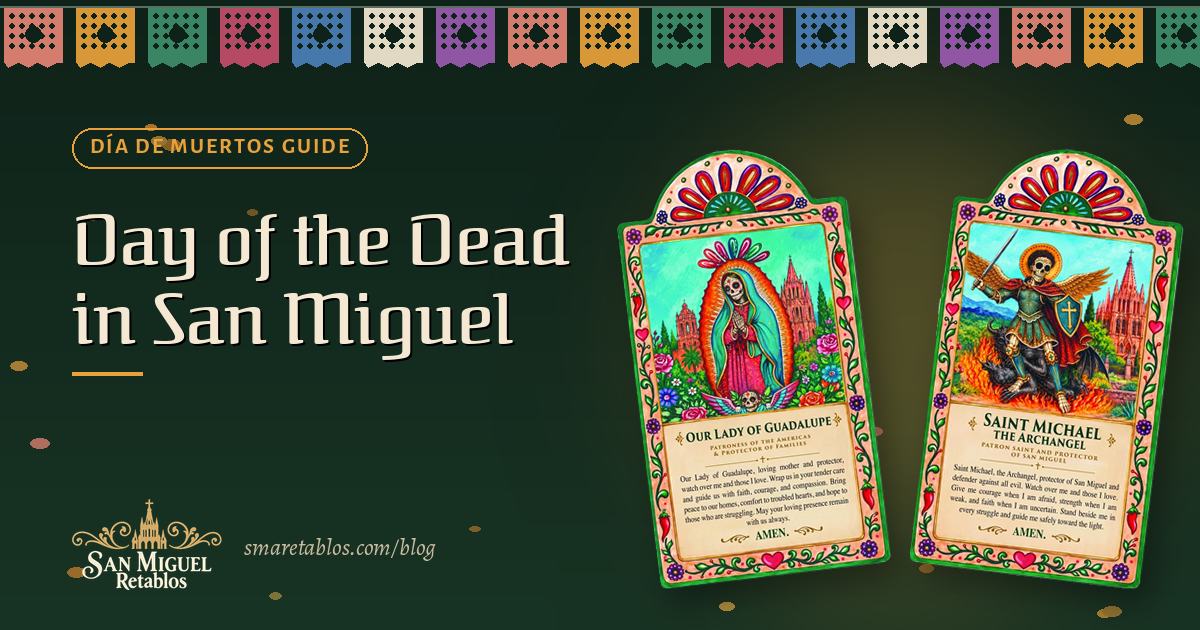
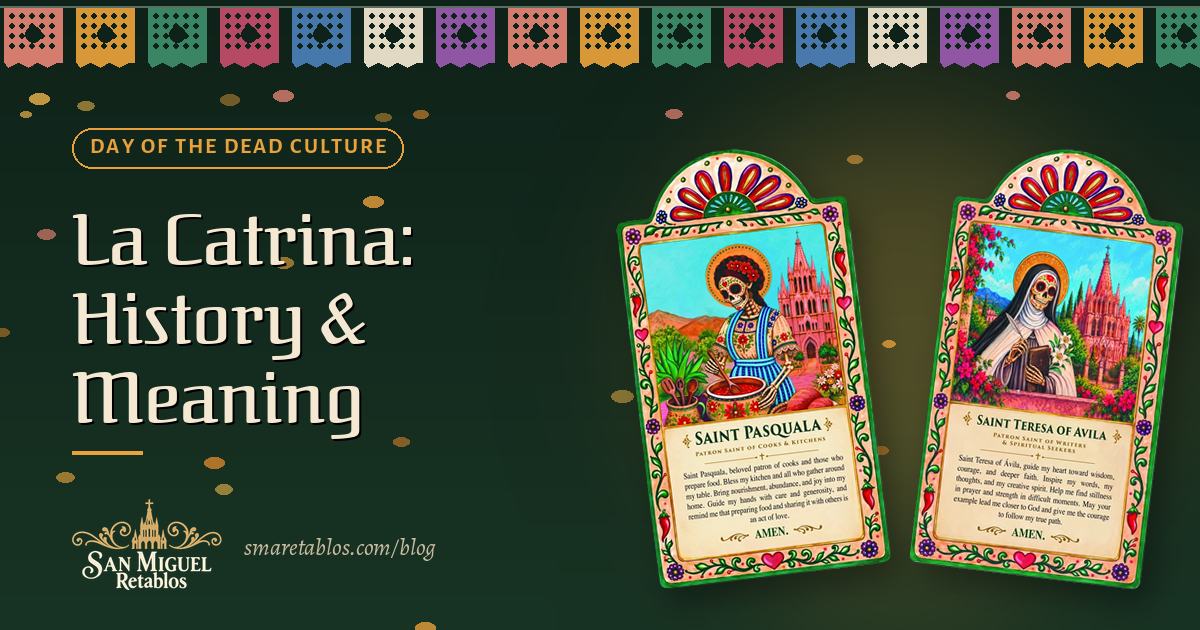
At San Miguel Retablos, the artist Leslie Kate paints each saint as a Catrina standing in front of San Miguel's pink Parroquia. It is not meant as irreverence. The Catrina face speaks of the beauty of life, of the continuity of the soul beyond death, and of remembrance, the same themes found in the lives of the saints.
Think of Saint Teresa of Ávila, who wrote about the soul's journey toward God, or Our Lady of Guadalupe, who has accompanied Mexican families for centuries. Painted as Catrinas, they belong both to the faith and to the folk art of Mexico, in the same way the Day of the Dead itself joins Catholic and Indigenous traditions.
Frequently asked questions
Who created La Catrina?
The engraver José Guadalupe Posada created the original skeleton, La Calavera Garbancera, around 1912. Diego Rivera later gave her a full body and the name La Catrina in his 1947 mural.
What does the word Catrina mean?
It comes from catrín, a word for an elegant, well-dressed man. La Catrina is the feminine form, a fashionable lady.
Is it disrespectful to dress as a Catrina?
Many Mexicans welcome it when it is done with respect. Learning the story of La Catrina and the meaning of the Day of the Dead is the best way to honor the tradition.
Where can I see Diego Rivera's Catrina mural?
Sueño de una tarde dominical en la Alameda Central is displayed at the Museo Mural Diego Rivera in Mexico City, next to the Alameda Central park.
Each retablo from San Miguel Retablos shows a saint as a Catrina before the Parroquia of San Miguel de Allende. Our Saint Teresa of Ávila retablo is a favorite with writers and spiritual seekers.

About the author: Lesley B. Fay
Lesley B. Fay runs San Miguel Retablos from her studio at Hidalgo 52A in the Centro of San Miguel de Allende, Mexico, where she creates Catrina saint retablos with artist Leslie Kate. She writes about the traditions, saints and celebrations behind each piece.
Sources
- nationalgeographicla.com — www.nationalgeographicla.com/historia/2024/10/que-es-la-catrina-y-que-representa-en-el-dia
- culturagenial.com — www.culturagenial.com/es/la-catrina-de-jose-guadalupe-posada/
- mexicodesconocido.com.mx — www.mexicodesconocido.com.mx/calaveras-de-dia-de-muertos-y-calaveritas-literarias-versos-d
- ich.unesco.org — ich.unesco.org/en/RL/00054