Mexican folk art
Papel Picado: Meaning, History, Colors and How to Make Your Own

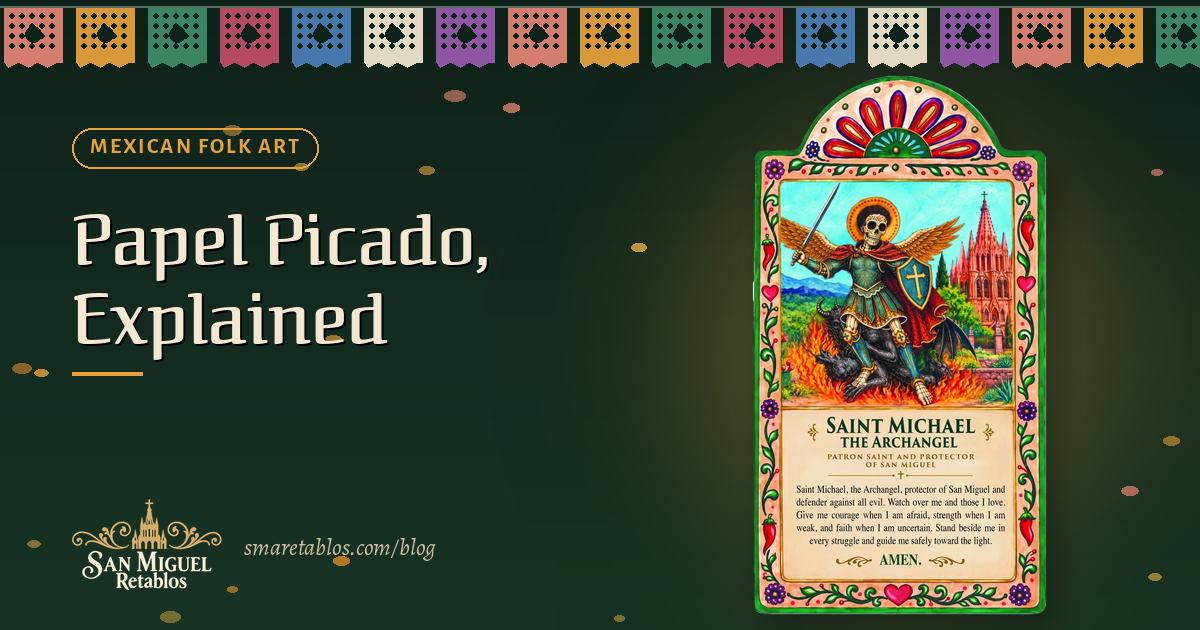
Papel picado means "perforated" or "pierced paper": colorful sheets of tissue paper cut into lacy designs and strung into banners. It is one of Mexico's best-loved folk arts, hung over streets for fiestas and draped across altars for the Day of the Dead, where it is often said to represent air, one of the four elements of the ofrenda.
Its home is San Salvador Huixcolotla, a town in the state of Puebla that is considered the birthplace of the craft and where artisans still cut papel picado by hand with chisels. Here is the story, the meaning of the colors, and a simple way to make your own.
Where papel picado comes from
Long before tissue paper, the peoples of central Mexico made amate, a paper from tree bark, and cut figures into it for ceremonies. Historians debate how directly that practice led to papel picado, but the love of cut and painted paper runs deep in Mexico.
The modern craft took shape when colored tissue paper, called papel de China, became available to rural Mexicans, often through hacienda stores, in the 19th century. In San Salvador Huixcolotla, artisans began cutting it into intricate patterns, and by the 1920s the town was known for its banners. The craft spread to neighboring regions, then to Mexico City, and by the 1970s papel picado was a common sight in streets and on altars across central Mexico, and later in the United States.
In 1998, the state of Puebla declared the artisanal papel picado of Huixcolotla part of its cultural heritage.
How artisans make it
A master artisan does not cut one sheet at a time. They stack dozens of sheets of tissue paper, often 40 to 50, on a soft lead base, lay a paper stencil on top, and strike through the whole pile with small chisels and a mallet. Every sheet in the stack comes out with the same design. The finished pieces are glued or sewn over a string to make a banner.
Today you will also see plastic papel picado, which survives rain and sun outdoors, and machine-cut versions. Both have their place, but hand-cut tissue paper has a softness and a rustle that is hard to copy. When you can, buy from the artisans who keep the tradition alive.
What the colors mean
There are no fixed rules, and meanings vary from family to family and region to region. These are the associations people commonly mention for the Day of the Dead:
- Purple: the Catholic faith and mourning.
- Orange and yellow: the color of the marigold and of light, often linked to the offering itself; some sources tie orange to mourning and yellow to the elderly.
- White: purity, often associated with children who have died.
- Red: commonly linked to blood.
- Blue: in some lists, those who died in water.
- Black: mourning and the underworld.
- Green: sometimes associated with youth or with those who died young.
Papel picado for the Day of the Dead and every fiesta
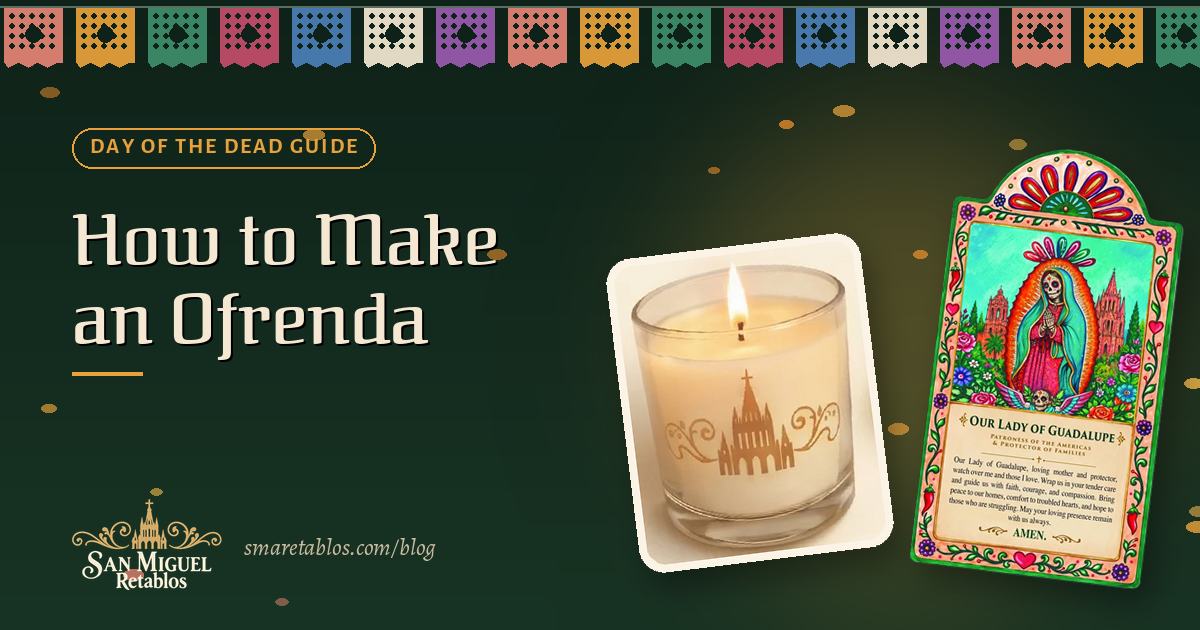
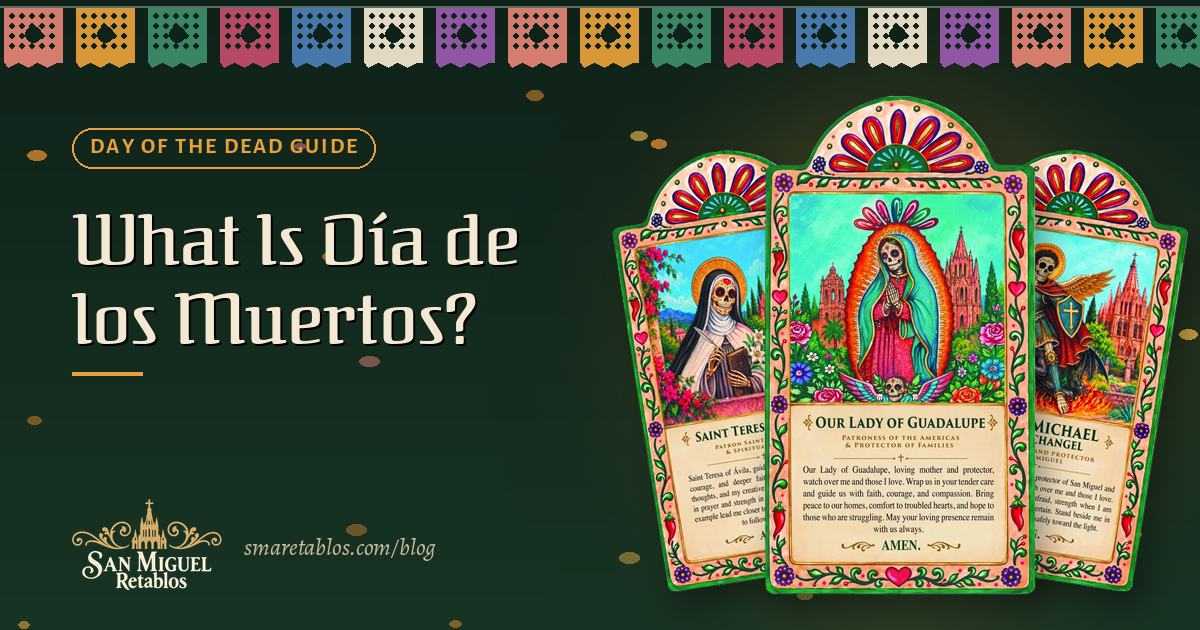
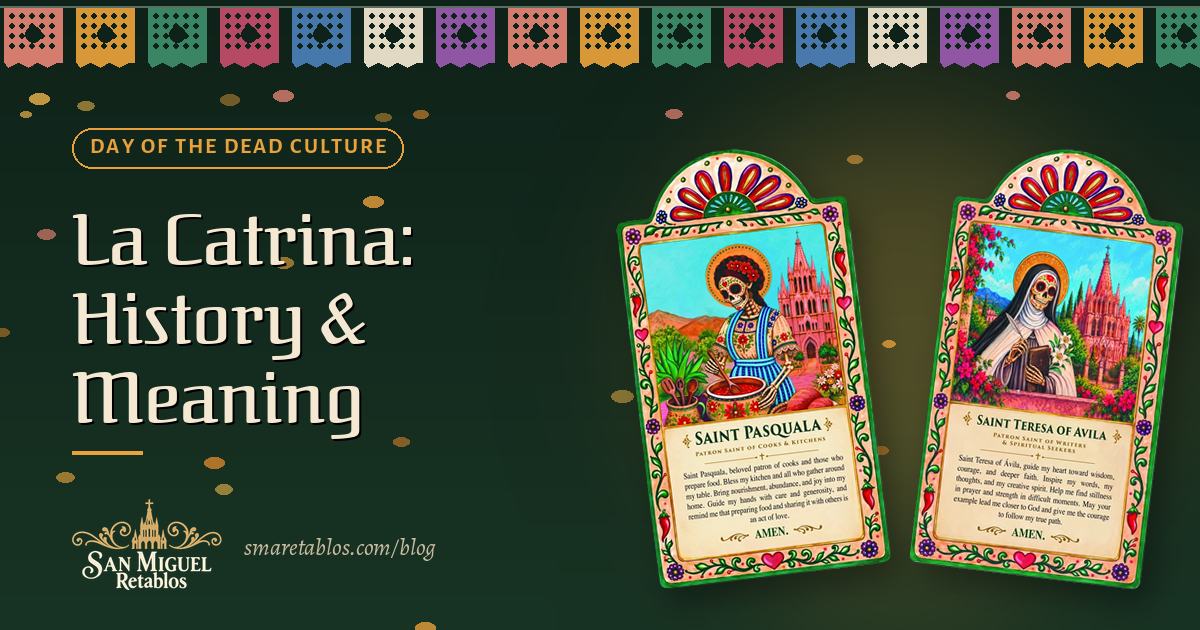
On an ofrenda, papel picado is hung across the top of the altar or along its edges, and the way it flutters when a door opens is part of its charm. Designs feature calaveras, Catrinas, crosses, flowers and sometimes names. For your own altar, pair the banners with marigolds, candles and a saint image such as our Saint Michael the Archangel retablo. Read more about La Catrina and the Day of the Dead.
The same art dresses every celebration. Green, white and red banners fly for the Fiestas Patrias in September, white lace-like banners with doves and hearts are hung for weddings, red and green ones for Christmas, and town squares fill with color for each patron saint's feast.
How to make a simple papel picado at home
This is the easy, scissors version, perfect for children or for a family altar.
- Gather: colored tissue paper, scissors, a pencil, glue stick and a long piece of string or twine.
- Cut the tissue paper into rectangles, about 8 × 11 inches (20 × 28 cm).
- Fold a strip about an inch (2.5 cm) wide along the top edge and leave it uncut. This is where the string will go.
- Fold the sheet in half lengthwise, then in half again, and once more for a smaller, more detailed pattern.
- Cut small shapes along the folds: triangles, half circles, diamonds, hearts. Keep cuts away from the top strip.
- Unfold gently and press flat under a book.
- Glue the top strip over the string, leaving a little space between flags, and hang your banner across the altar or a doorway.
Frequently asked questions
What does papel picado symbolize on a Day of the Dead altar?
It is commonly said to represent air or wind, one of the four elements on the ofrenda, and its fragile paper is often read as a reminder of how delicate life is.
Where is papel picado from?
San Salvador Huixcolotla, in the state of Puebla, is considered the birthplace of the craft, and in 1998 Puebla declared its artisanal papel picado part of the state's cultural heritage.
Do the colors of papel picado have fixed meanings?
No. People commonly associate purple with faith and mourning, white with children and purity, and orange with marigolds, but families and regions use colors in their own ways.
Can I hang papel picado outdoors?
Tissue paper fades and tears in sun and rain, so for outdoor use choose plastic papel picado, or hang tissue banners under a roof.
Papel picado and a saint make a joyful altar. Our Saint Michael retablo shows San Miguel's own patron as a Catrina in front of the Parroquia, and it sits beautifully beneath a string of fluttering paper.

About the author: Lesley B. Fay
Lesley B. Fay runs San Miguel Retablos from her studio at Hidalgo 52A in the Centro of San Miguel de Allende, Mexico, where she creates Catrina saint retablos with artist Leslie Kate. She writes about the traditions, saints and celebrations behind each piece.
Sources
- en.wikipedia.org — en.wikipedia.org/wiki/Papel_picado
- mexican-folk-art-guide.com — www.mexican-folk-art-guide.com/papel-picado.html
- eluniverso.com — www.eluniverso.com/larevista/sociedad/que-significa-el-papel-picado-de-dia-de-muertos-nota
- ich.unesco.org — ich.unesco.org/en/RL/00054