Day of the Dead flowers
Why Are Marigolds Used for the Day of the Dead? The Meaning of Cempasúchil

Marigolds are used for the Day of the Dead because, according to tradition, their bright orange color and strong scent guide the souls of the dead back to their families. In Mexico this flower is called cempasúchil, or simply flor de muerto, the flower of the dead. Families place it on the ofrenda, on graves, and scatter its petals in a path from the door to the altar so the souls can find their way.
The flower is Tagetes erecta, a marigold native to Mexico, and its use goes back to pre-Hispanic times. Its name comes from Nahuatl, and the 16th-century Florentine Codex already describes it as a ceremonial and decorative plant.
Here is what the cempasúchil means, where its name comes from, and how to use it in your own home.
Where the name cempasúchil comes from
Cempasúchil comes from the Nahuatl word cempohualxóchitl, formed from cempohualli, twenty, and xóchitl, flower. It is usually translated as twenty flowers or flower of twenty, which many people link to its many layers of petals. You will also see it spelled cempazúchil or cempoalxóchitl.
In everyday Mexican Spanish people often call it flor de muerto. In English it is known as the Mexican marigold or Aztec marigold.
What marigolds mean on the Day of the Dead
In pre-Hispanic times, the yellow-orange color of the cempasúchil was associated with the sun, and the flower was placed in tombs because it was believed to hold the warmth of the day. Today its meaning on the Day of the Dead centers on guidance and welcome:
- Light and color: its glowing orange is seen as a light that leads the souls home.
- Scent: its strong, earthy fragrance is said to help the dead find their way.
- Welcome: a home filled with cempasúchil tells the visiting souls that they are expected and loved.
- The cycle of life: the flower blooms at the end of the rainy season, around the time of the maize harvest that UNESCO notes the festivity also marks.
The petal path: guiding the souls home
One of the most beautiful customs is the camino de flores, the path of petals. Families pull the petals from the flower heads and lay a trail from the street or front door to the ofrenda. UNESCO describes how families in Mexico guide the souls home by laying flower petals and candles along the way from the cemetery to their houses.
In many towns, the same golden paths lead through cemeteries, where graves are covered with marigolds and candles for the vigil of November 1 and 2. Some families shape the petals into crosses on the floor or on the grave.
How to use marigolds at home
- On the ofrenda: place whole flowers in vases or jars on each level, or weave them into an arch above the altar.
- As a petal path: scatter petals from your front door to the ofrenda. Indoors, a short path still carries the meaning.
- As garlands: string the flower heads on thread to make garlands for the altar or a doorway.
- With other flowers: many altars also use white baby's breath, called nube, and purple cockscomb, called mano de león or terciopelo.
- Keep them fresh: buy them a day or two before you set up your ofrenda and keep the stems in cool water.
Where to find cempasúchil
In Mexico, markets overflow with cempasúchil in the second half of October, sold in large bunches at modest prices. In the US, look for Mexican marigolds at Latino markets, flower markets and many florists in late October. If you cannot find cempasúchil, other orange or yellow marigolds work well. You can also grow your own: in Mexico the plant is usually sown in the spring and summer months to flower by autumn.
If you love gardens and flowers, you may also feel close to Saint Francis of Assisi, the saint of animals and all of creation, whose Canticle of the Creatures praises God through the sun and the earth with its flowers.
More than an altar flower
The cempasúchil has a long life beyond the ofrenda. It has been used in traditional medicine, as a natural dye for fabrics and foods, and even in poultry feed to give a deeper color to egg yolks. Still, for most Mexicans, its scent is simply the smell of late October, when families get ready to receive their dead. Pair it with papel picado and candles and your altar will feel complete.
Frequently asked questions
Why are marigolds the flower of the dead?
Their bright orange color and strong scent are believed to guide the souls of the dead back home. The tradition goes back to pre-Hispanic Mexico, where the flower was linked with the sun.
What does cempasúchil mean?
It comes from the Nahuatl cempohualxóchitl, from cempohualli, twenty, and xóchitl, flower. It is usually translated as twenty flowers or flower of twenty.
Why do people make a path of marigold petals?
The petal path leads from the door or street to the ofrenda so that the visiting souls can find their way to the altar prepared for them.
Can I use regular marigolds for my ofrenda?
Yes. Mexican cempasúchil is ideal, but other orange or yellow marigolds are a good substitute when it is not available.
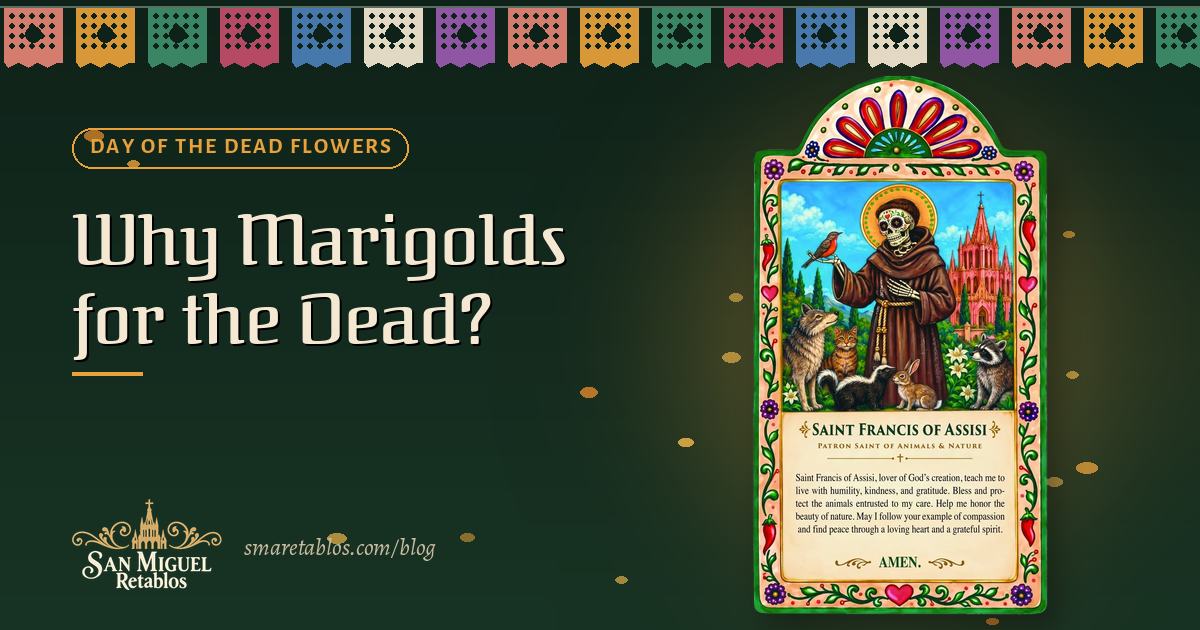
At San Miguel Retablos our Saint Francis of Assisi retablo celebrates the beauty of creation, painted as a Catrina before San Miguel's pink Parroquia. Set beside a vase of cempasúchil, it makes a lovely touch on any altar.

About the author: Lesley B. Fay
Lesley B. Fay runs San Miguel Retablos from her studio at Hidalgo 52A in the Centro of San Miguel de Allende, Mexico, where she creates Catrina saint retablos with artist Leslie Kate. She writes about the traditions, saints and celebrations behind each piece.
Sources
- nationalgeographicla.com — www.nationalgeographicla.com/historia/2024/10/los-4-datos-curiosos-de-la-flor-de-cempasuch
- expansion.mx — expansion.mx/tendencias/2025/10/21/flor-de-cempasuchil-significado-dia-de-muertos
- ich.unesco.org — ich.unesco.org/en/RL/00054
- personal.unam.mx — www.personal.unam.mx/Docs/Cendi/dia-de-muertos-elementos-de-la-ofrenda.pdf